Low Maintenance: Fewer components and no batteries involved.
Grid Support: You have power even when solar production is low (provided the grid is available).
Government Subsidies: Eligible for various state and central subsidies.
On-Grid Setup
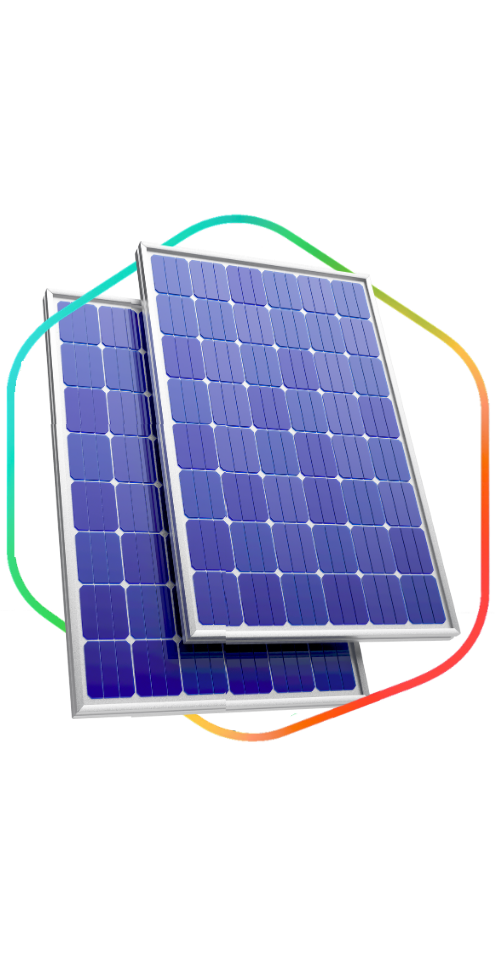
An On-Grid Solar System, also known as a Grid-Tied Solar System, is a solar power setup that is directly connected to the utility power grid. This is the most commonly used system for homes, commercial buildings, and industries in urban and semi-urban areas.
How It Works:
Solar Panels absorb sunlight and convert it into DC electricity.
A Solar Inverter converts DC electricity into AC electricity, which is usable by household or commercial appliances.
The electricity generated is used to power the connected load.
Surplus energy is sent back to the power grid via net metering.
During the night or low sunlight conditions, electricity is drawn from the grid.
Key Features:
Requires a connection to the local power grid.
Does not include batteries for energy storage.
Enables net metering, allowing consumers to earn credits for excess electricity supplied to the grid.
Highly efficient and cost-effective for areas with reliable grid availability.
Limitations:
Not functional during power outages unless paired with a hybrid inverter or backup system.
Depends entirely on grid connectivity.
If you have a roof of area 100-200 Sq. Ft.
-- 1 kVA On-Grid Solar Inverter (Single Phase)
-- 4 nos Modules of 320Wp each
-- Cables & Other Accessories
-- You generate 1,400 units annually
If you have a roof of area 200~300 Sq. Ft.
-- 2 kVA On-Grid Solar inverter (Single Phase)
-- 7 nos Modules of 320Wp each
-- Cables & Other Accessories
-- You generate 2,800 units annually
If you have a roof of area 300~500 Sq. Ft.
-- 3 kVA Grid Tie Solar Inverter (Single Phase/Three Phase)
-- 10 nos Modules of 320Wp each
-- Cables & Other Accessories
-- You generate 4,200 units annually
If you have a roof of area 500~700 Sq. Ft.
-- 5 kVA Grid Tie Solar Inverter (Single Phase/Three Phase)
-- 16 nos Modules of 320Wp each
-- Cables & Other Accessories
-- You generate 7,000 units annually
If you have a roof of area 700-1000 Sq. Ft.
-- 8 kVA Grid Tie Solar Inverter (Three Phase)
-- 24 nos Modules of 320Wp each
-- Cables & Other Accessories
-- You generate 8,400 units annually
If you have a roof of area 1000~1200 Sq. Ft.
-- 10 kVA Grid Tie Solar Inverter (Three Phase)
-- 32 nos Modules of 320Wp each
-- Cables & Other Accessories
-- You generate 14,000 units annually
Off-Grid Setup
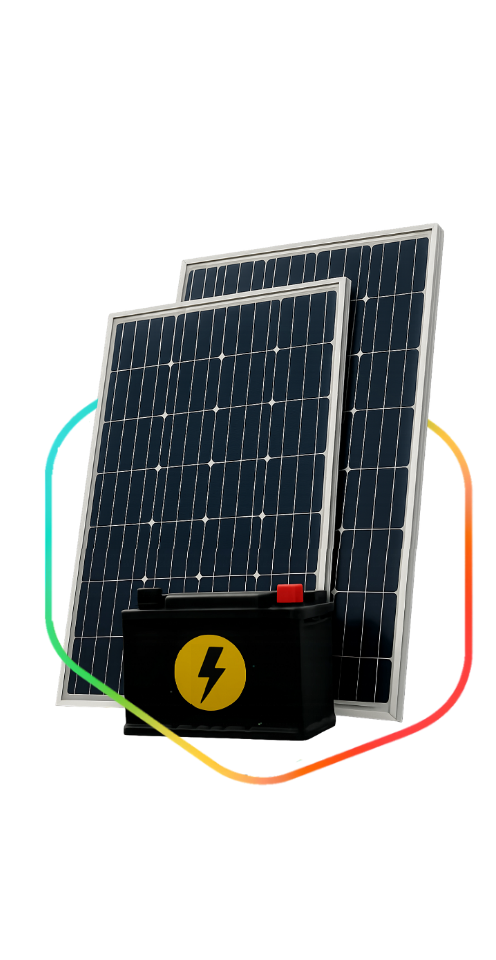
An Off-Grid Solar System is a self-sufficient solar power solution that operates independently of the utility power grid. It is ideal for remote or rural areas where grid electricity is either unavailable or highly unreliable.
How It Works:
Solar Panels capture sunlight and generate DC electricity.
A Solar Charge Controller regulates the voltage and current from the panels to prevent battery overcharging.
Electricity is stored in batteries for use during night or cloudy days.
A Solar Inverter converts DC power from the batteries to AC power for home or commercial use.
Key Features:
Operates independently of the electricity grid.
Includes battery storage for round-the-clock energy supply.
Designed to meet all energy needs even during power cuts or at night.
Ideal for remote locations, agricultural lands, and mobile units like caravans.
Limitations:
Higher initial cost due to batteries and charge controllers.
Requires proper sizing to match load requirements.
Battery maintenance and eventual replacement costs.
Benefits:
Complete energy independence — no reliance on power grid.
Power availability 24/7, even in off-grid regions.
Zero electricity bills — all energy needs are met through solar.
Highly reliable during grid failures or outages.
If you have a roof of area 100-200 Sq. Ft.
-- 2 kVA PCU (Single Phase)
-- 4 nos Modules of 320Wp each
-- 2 nos Batteries of 12V / 150Ah each
-- Cables & Other Accessories
-- You generate 1,400 units annually
If you have a roof of area 200~300 Sq. Ft.
-- 3.75 kVA PCU (Single Phase)
-- 7 nos Modules of 320Wp each
-- 4 nos Batteries of 12V / 150Ah each
-- Cables & Other Accessories
-- You generate 2,600 units annually
If you have a roof of area 300~500 Sq. Ft.
-- 6.25 kVA PCU (Single Phase)
-- 12 nos Modules of 320Wp each
-- 8 nos Batteries of 12V / 150Ah each
-- Cables & Other Accessories
-- You generate 5,000 units annually
If you have a roof of area 500~700 Sq. Ft.
-- 7.5 kVA PCU (Single Phase)
-- 16 nos Modules of 320Wp each
-- 10 nos Batteries of 12V / 150Ah each
-- Cables & Other Accessories
-- You generate 7,000 units annually
Hybrid Setup
A Hybrid Solar Setup is a solar power system that combines the features of both on-grid and off-grid systems. It uses solar panels, a battery bank, and is also connected to the main electricity grid. This setup allows users to generate their own solar energy, store excess power in batteries for backup, and draw power from the grid when needed.
Key Components of a Hybrid Solar System:
Solar Panels: Capture sunlight and convert it into electricity.
Hybrid Inverter: Manages power flow between the solar panels, batteries, and grid.
Battery Bank: Stores excess energy for use during night or power cuts.
Grid Connection: Acts as a backup when solar and battery power are insufficient.
Benefits:
Uninterrupted Power Supply: Provides electricity even during power outages.
Efficient Energy Use: Uses solar energy first, then battery, and finally the grid.
Lower Electricity Bills: Reduces dependence on grid electricity.
Smart Power Management: Automatically switches between power sources as needed.
Homes and businesses that face frequent power cuts.
Areas where solar power generation is high during the day but energy is needed at night too.
Ideal For:
In short, a hybrid solar setup offers the best of both worlds—energy independence and grid support, making it a smart and reliable solution for sustainable power.